
Physics-Informed Surrogate Models for FEA and CFD
A physics-informed surrogate model approximates an expensive FEA or CFD simulation at a fraction of the compute cost, so studies that need hundreds or thousands of evaluations become practical. In INNX research on a composite laminate panel, a physics-informed graph neural network (GNN) surrogate ran 60× faster than FEA with under 3% error against the FEA ground truth. The service also covers statistical and machine learning consulting for engineering data: design of experiments, uncertainty quantification, and model validation.
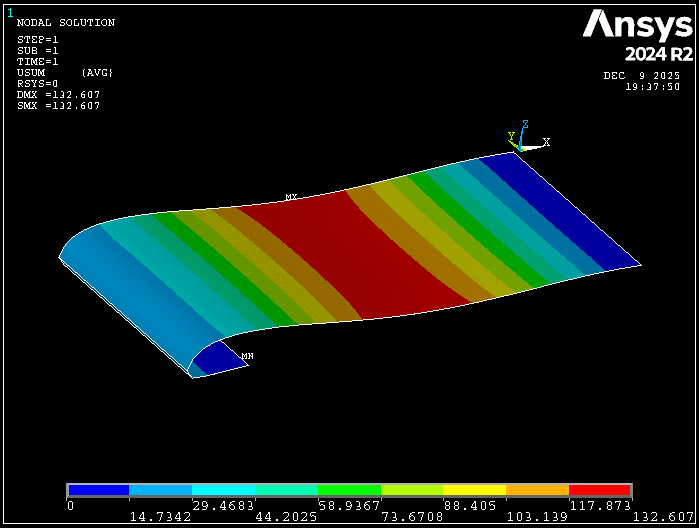
FEA ground truth: displacement field of a composite laminate panel.
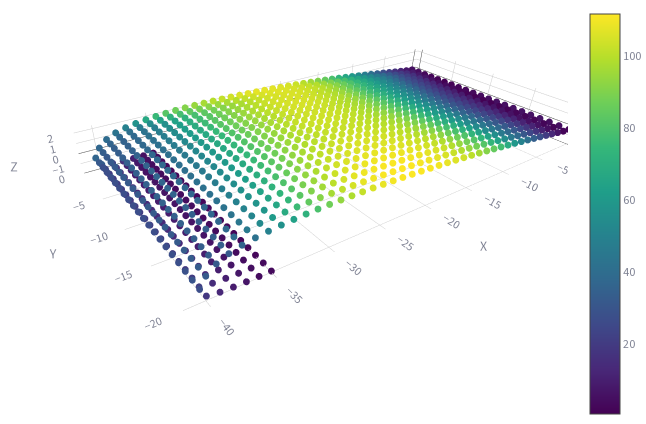
Physics-informed GNN surrogate: prediction of the same field, 60× faster than FEA, with under 3% error.
Typical problems
- A parametric or design study that needs more FEA or CFD runs than the schedule or the compute budget allows.
- An optimization loop that is too slow because every evaluation is a full simulation.
- Scatter in material properties, geometry, or loads whose effect on the result has to be quantified, not guessed.
- Test or simulation data that needs a statistical analysis before it can support a design decision.
- A model, physical or data-driven, that has to be validated before anyone relies on it.
What you receive
- A surrogate model of your simulation, with its error measured against FEA or CFD results that were not used to train it.
- A design of experiments: which simulations or tests to run, and why, for the least cost.
- Uncertainty quantification: how the scatter in the inputs propagates to the quantities your design depends on.
- A written report of the data, the model, its validation, and its limits.
- Before any work begins, a fixed-scope proposal with clear deliverables, timeline, and price. No open-ended hourly billing.
Methods & tools
Physics-informed graph neural networks. A finite element mesh is a graph: nodes connected by elements. A GNN works directly on that graph, so it can learn a field such as displacement or stress on the geometry itself. Making it physics-informed means the physics of the problem is built into the model or its training, rather than learned from data alone.
Ground truth. The training and validation data come from FEA and CFD models that are themselves verified: Code_aster for structures and OpenFOAM for flows, with the same checks as in the published case studies.
Design of experiments, uncertainty quantification, and model validation. Statistical methods to choose the runs, propagate the uncertainty, and measure how far a model can be trusted. Implemented in Python and C.
Use in optimization. A validated surrogate can stand in for the full model inside a structural optimization, with the final design checked on the full model.
Industries
Aerospace, defense, energy, marine, automotive, and sports equipment: wherever a simulation is run many times, or a design decision depends on data with scatter.
Typical pricing
Most focused engineering-analysis projects range from $3,000 to $15,000. Complex composite, CFD, optimization and certification-support engagements typically range from $15,000 to $40,000+. Hourly technical support is available from $110/hour.
| Engagement | Typical range (USD) |
|---|---|
| Technical review | $500–$1,500 |
| FEA or CFD screening study | $3,000–$7,500 |
| Detailed analysis and report | $7,500–$20,000 |
| Advanced composite, optimization or certification support | $15,000+ |
| Rush work | quoted separately |
Final pricing depends on scope, number of load cases, model maturity, reporting requirements and schedule. Every project is quoted as a fixed price before work begins; see the three ways to scope a project.
Related case studies
A full write-up of the GNN surrogate study on the composite laminate panel is in preparation. Meanwhile, the published case studies show how the FEA models used as ground truth are verified.
FAQ
How accurate is a surrogate model compared with FEA?
On the composite laminate panel study, the physics-informed GNN surrogate stayed under 3% error against the FEA ground truth while running 60× faster. Accuracy depends on the problem and the training data, so it is measured against simulations that were not used for training.
Do you also offer general statistics and machine learning consulting?
Yes: statistical and ML consulting for engineering data, including design of experiments, uncertainty quantification, and model validation.
What software and tools do you use?
OpenFOAM for CFD, Code_aster for FEA, and Python and C for custom analysis, optimization, and automation, including in-house-built solvers where off-the-shelf tools fall short.
How does an engagement start?
With a technical scoping review request. You get a reply within one business day, then a short call to check fit and scope. Well-defined projects receive a fixed-price proposal with clear deliverables and timeline; unclear or technically risky projects start with a paid scoping engagement, credited toward the project if you proceed. No open-ended hourly billing.